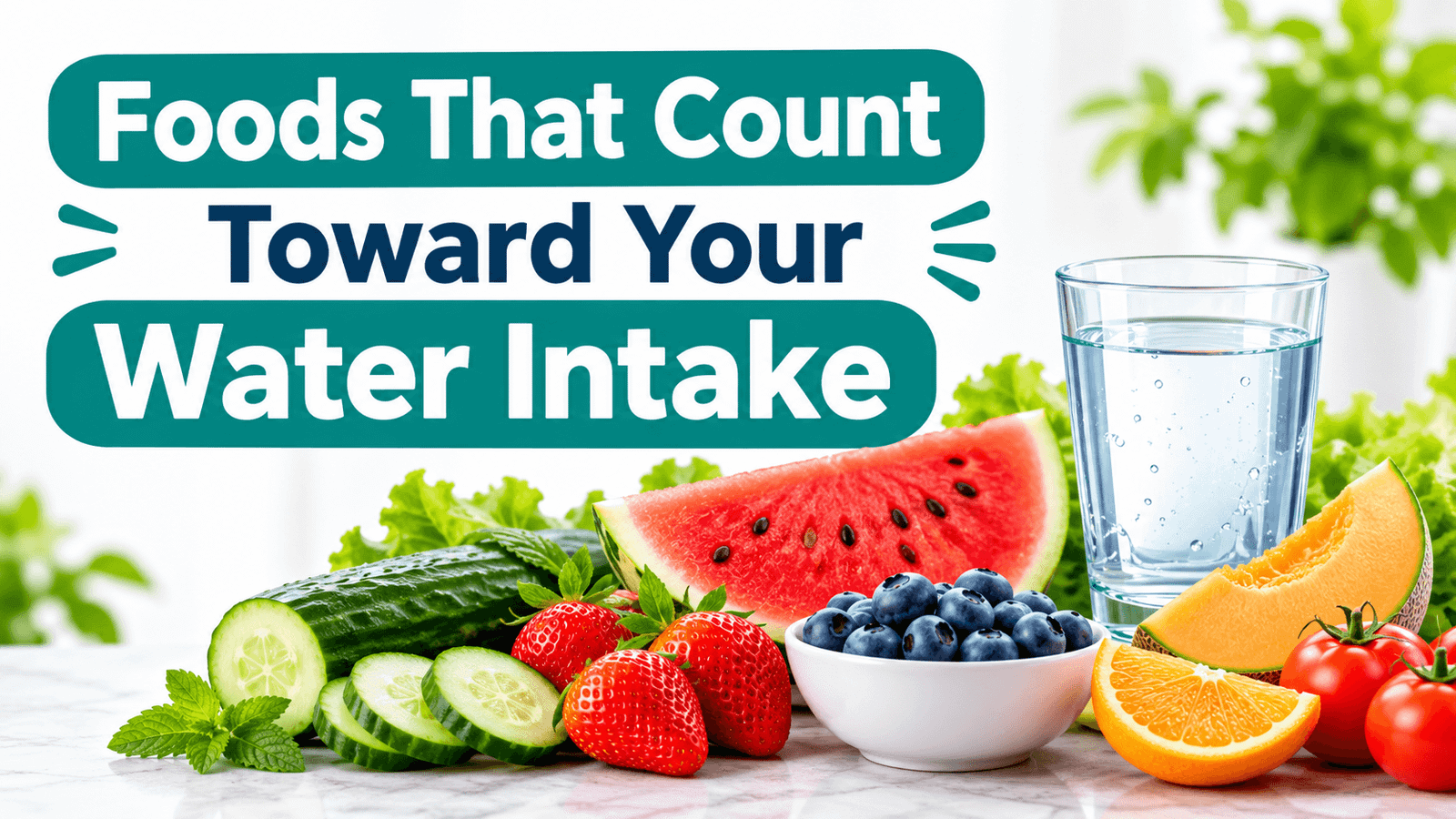
Foods That Count Toward Your Water Intake
A 300 gram bowl of watermelon holds about 270 ml of water. This site leaves that moisture with the meal and estimates drinking fluid on its own.
Last updated November 18, 2026.
This page explains how food moisture relates to the drinking figure on this site. It is not medical advice. Read the health disclaimer before you treat a number as a goal.
Two columns, one day
Water arrives in two columns. One is what you drink. The other is the water already inside food. Published adequate intakes describe both columns together. Survey work behind the National Academies' water reference put roughly a fifth of total water in the food column for people in the United States, with the rest in beverages.
Apply that share to the published totals and the food column becomes a concrete amount. A fifth of the 3.7 liter total-water figure often cited for men is about 0.74 liters. A fifth of the 2.7 liter figure often cited for women is about 0.54 liters. Those are group pictures, including food. They are not a cup target for a single lunch.
This site's formula aims at the drink column. The rates of 35 ml per kilogram and 40 ml per kilogram are a planning baseline for fluids you drink. They already sit near the beverage portion of those published totals. Food is acknowledged, and then left out of the arithmetic, so the result is something you can pour.
A bowl of watermelon is food moisture
Watermelon is about 91 percent water by weight, using rounded food-composition figures. A 300 gram bowl is a generous snack, not a whole melon. Ninety-one percent of 300 grams is about 273 grams of water. A gram of water is a milliliter, so the bowl holds about 270 ml.
That is a bit more than half of a 500 ml bottle. It is real water. On this site it stays in the food column. The drinking target does not drop by 270 ml because the bowl was finished. The published totals already expected food to carry part of the day's water. Subtracting the bowl from a drinking estimate would count that moisture a second time: once inside the backdrop those totals provide, and again as a deduction from the glass.
The same bowl does matter if someone is eating almost no produce, soup, or yogurt and wondering why the food column looks empty. In that pattern, drinks carry nearly the whole day. The drinking target on this site is already the drink column, so the practical response is to keep pouring drinks, not to invent a larger formula.
Approximate water by weight
The percentages below are rounded from public food-composition data. They describe the share of the food's weight that is water. They are not servings, and they are not a score you add up to replace a drinking plan.
| Food | Water, about | What a typical portion holds |
|---|---|---|
| Cucumber, raw | 95% | 100 g is about 95 ml |
| Watermelon | 91% | 300 g is about 270 ml |
| Strawberries | 91% | 150 g is about 135 ml |
| Orange | 87% | 180 g is about 155 ml |
| Milk | 88% | Counted with drinks on this site |
| Plain yogurt | 85% | 170 g is about 145 ml |
| Cooked white rice | 68% | A cup is moist, and still a side dish |
| Bread | 36% | A slice adds little water |
| Almonds | 4% | A handful is almost dry |
Milk is in the table because it is wet, and it is marked as a drink because this site counts a glass of milk with coffee, tea, and water. Yogurt stays in the food column. Soup eaten with a spoon stays with the meal. A mug of broth you drink like tea joins the drink column. The same liquid should land in one column only.
Why the drinking number ignores the plate
A person who tries to "eat their water" and then skips drinks is using the food column as if it were the whole day. Even a produce-heavy pattern, in the survey picture, is about a fifth of total water, not the full amount. The other four fifths still have to be drunk. A day of cucumber, orange, and yogurt can fill much of that food fifth. It does not retire the drink column.
Run the food fifth against this site's own baseline to see the scale. A 60 kg woman has a sedentary drinking baseline of 60 times 35 ml, which is 2,100 ml. A fifth of a larger total-water picture might be around half a liter of food moisture. Those half-liters are not subtracted from the 2,100 ml. The 2,100 ml is the pour. The half-liter is the plate.
Cooking changes the share. Rice absorbs water and moves from a dry grain to a food that is roughly two-thirds water. Grilled meat loses moisture. A raw cucumber and a baked cucumber are not the same entry. The table uses raw produce and plain cooked staples so the comparison stays simple.
What this page will not turn into
There is no food score to hit, and no list of produce that "hydrates better" than water. Water in a cucumber is water. It arrives with fiber, potassium, and the rest of the food. That is a reason to eat the cucumber. It is not a reason to treat the cucumber as a bottle.
Children under 14 are outside this site's drinking formula, and this table does not replace pediatric guidance. People who have been given a fluid limit should follow that limit. A watermelon bowl does not create room to ignore it. Pregnancy and breastfeeding change total water needs, and this page does not add a produce bonus for those stages.
The drinking figure, built from weight, age, activity, and climate, is on the water intake calculator. Use this guide when you want to know why a wet meal did not reduce that figure.
Questions
Should I lower my drinking target after a bowl of watermelon?
On this site, no. The drinking target estimates fluids you drink. The water in watermelon stays in the food column. Subtracting it from the drinking number would count food moisture a second time.
Does a bowl of soup count as food or as a drink?
If you eat it with a spoon as part of a meal, this site leaves it in the food column. If you drink a mug of broth the way you would drink tea, count that mug with your other drinks. The same liquid should be counted once.
Do dry foods such as bread and nuts add meaningful water?
Very little. Bread is roughly a third water by weight, and almonds are only a few percent. A produce-heavy meal moves the food column. A handful of nuts barely moves it.
Sources
The one-fifth food share is the survey picture reported with the National Academies' water reference. The percentages in the table are rounded from food-composition data. The decision to estimate drinks only is this site's planning choice.
- National Academies, Dietary Reference Intakes for Water, Potassium, Sodium, Chloride, and Sulfate (2005), summary of water findings
- USDA FoodData Central
- EFSA Journal, Scientific Opinion on Dietary Reference Values for water (2010)
- Harvard T.H. Chan School of Public Health, The Nutrition Source: Water